


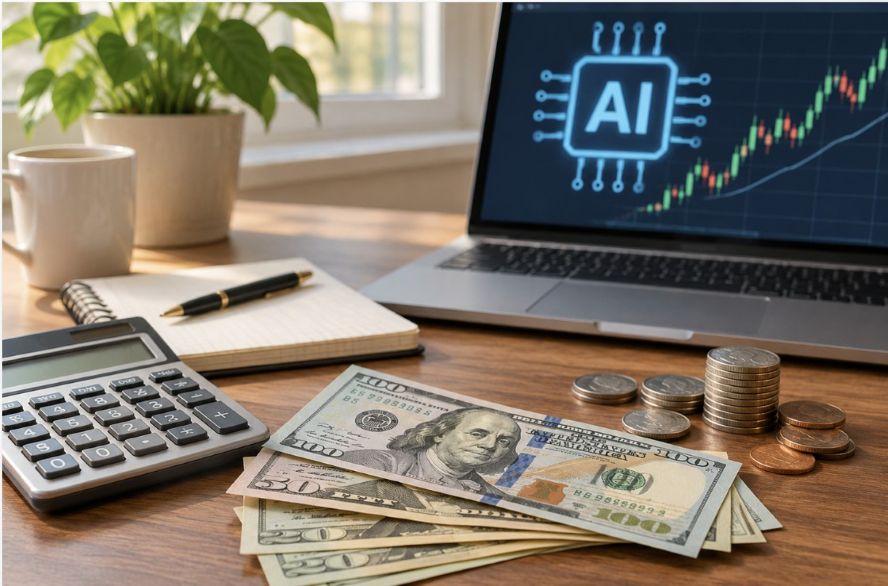
Artificial intelligence could usher in an era of extraordinary prosperity, but also unemployment, concentration of wealth, and major financial crises. In an analysis published by the American magazine The Atlantic , journalist Ross Andersen examines what could happen to people's savings, investments, and property if advanced AI systems transform the economy over the coming years.
In the article published on October 28, 2026, Andersen argues that uncertainty around the development of artificial intelligence is also raising new questions about personal finances.
According to him, the problem is that the possible scenarios for the future are extremely different and each of them would require a different financial strategy.
The author discusses several possibilities, without claiming that any of them are certain.
Scenario One: Artificial Intelligence Makes Almost All Products Very Cheap
In the most optimistic scenario, AI could bring about tremendous scientific advances and increased productivity.
Andersen refers to the vision of Dario Amodei, the CEO of Anthropic, according to which artificial intelligence can significantly accelerate scientific discoveries.
In such a future, intelligent systems could contribute to the treatment of serious diseases, while automation could significantly reduce production and service costs.
The author also recalls a conversation with Sam Altman, the executive director of OpenAI.
Altman had described a future where solar-powered robots could build almost any type of house at very low cost.
According to this vision, people can have access to a standard of living that is considered very high today.
But even in such a world, some assets will remain rare.
Why can properties in specific locations retain value?
Andersen argues that, even if building houses becomes very cheap, the most desirable locations cannot be multiplied infinitely.
For example, land on the coast of Santa Barbara in California or in the West Village neighborhood of Manhattan is limited.
The author mentions the economic concept of positional goods, whose value is related to the rarity and status they provide.
In this scenario, properties in sought-after locations and rare collectibles can retain value even if other products become much cheaper.
He cites historical objects, works of art, and collectibles as examples.
However, this is part of a hypothetical scenario and not a guarantee that property or collection prices will increase.
Scenario Two: AI creates unemployment and insecurity for the middle class
The other scenario that The Atlantic discusses is less optimistic.
The author refers to a concept described by Molly Kinder, a former researcher at the Brookings Institution, who calls this potential period a messy middle, or a disorderly phase of economic transition.
In this scenario, artificial intelligence can automate more and more jobs, but the economic benefits are not immediately distributed to everyone.
Employees may face stagnant wages, fewer entry-level jobs, and difficulty advancing their careers.
Even highly educated employees may spend an increasing portion of their day controlling work produced by AI.
According to Andersen, this could create a situation where people still have mortgages, family expenses, and financial responsibilities, but income security is weakened.
Retirement savings could become even more important
In this scenario, the author examines the risk of people being forced to use retirement savings to cover everyday expenses.
He points out that premature withdrawal of these savings can reduce the benefit from long-term investment growth.
For American employees, he mentions 401(k) and Roth IRA accounts, which are used for retirement savings.
Andersen suggests that, in such a period of uncertainty, keeping expenses under control and being willing to change residence or job can help people adapt.
However, these are possibilities that the author considers within his scenario, not universal advice for every family.
Scenario Three: Wealth Concentrates in the Owners of AI Companies
Another possibility is that artificial intelligence creates extraordinary wealth, but most of the benefits end up with a relatively small number of investors.
In this scenario, companies that develop the most advanced models could become among the most valuable businesses in history.
Andersen mentions OpenAI and Anthropic, which at the time of the article's publication were private companies.
This makes it more difficult for ordinary investors to directly purchase their shares.
The author also brings an unusual example from California.
A homeowner in Sonoma County had offered a $500 discount to buyers who could pay for the property with Anthropic stock.
According to Andersen, this case shows how sought-after participations in companies developing artificial intelligence have become.
The fund that gained over 400%, but then suffered huge losses
The article also focuses on Leopold Aschenbrenner, a former OpenAI researcher who founded the investment fund Situational Awareness.
Instead of investing in just one artificial intelligence company, Aschenbrenner focused on businesses that could benefit from the development of AI, regardless of which company would dominate the market.
According to The Atlantic, the fund had recorded growth of more than 400 percent during the year.
But during a market downturn, his public stock portfolio lost more than two-thirds of its value.
Aschenbrenner was forced to sell most of this portfolio in a single transaction.
The case illustrates the risks of investing concentrated in sectors with high volatility, even when the investor has correctly identified a long-term technological trend.
However, the decline in the public stock portfolio should not automatically be confused with the loss of the same percentage of the fund's total value.
What if AI causes a major attack on banks?
Another scenario the magazine examines relates to the security of the financial system.
Andersen cites warnings that advanced artificial intelligence systems could make cyberattacks more powerful.
In an extreme scenario, an attack on banks could cause service disruptions or compromise customer account balance data.
The author quotes Greg Jensen, chief investment officer at the Bridgewater Associates fund, who has warned of the risk of a major financial incident related to AI.
The magazine mentions that some financial institutions use backup systems, storing encrypted data on systems isolated from regular networks.
However, the author also examines the possibility that future cyberattack technologies will challenge these safeguards.
Cash, documents and savings in some institutions
In this context, Andersen presents several possible ways to prepare for major financial disruptions.
He mentions keeping important financial documents in physical form, spreading savings across more than one bank or financial institution, and keeping a limited amount of cash for emergencies.
The article also examines gold as a possible form of store of value.
However, the author points out that gold has practical difficulties, including safe storage, the risk of theft, and its use in small transactions.
These measures do not guarantee protection from a severe financial crisis and do not eliminate the usual risks of investment.
What if a much bigger disaster occurs?
In the final part of the analysis, Andersen addresses more extreme scenarios, including the malicious use of AI in biological or military attacks.
He mentions people preparing for disasters by buying isolated properties, stockpiling supplies, and building shelters.
However, according to the author, even these strategies have limitations.
In a major crisis, it may be difficult to reach a remote shelter or secure supplies for an extended period of time.
Andersen cites researchers who argue that living in stable communities, where people cooperate and help each other, may be a more useful form of crisis preparedness.
Does it make sense to give up saving for the future?
The article also mentions people who believe that the development of artificial intelligence will lead to the extinction of humanity.
Andersen quotes Nate Soares, president of the Machine Intelligence Research Institute, who has stated that he has stopped saving for retirement because he doesn't expect the world to continue to exist.
However, the author expressly states that this is not financial advice.
In a scenario of total extinction of humanity, no investment would matter anymore.
But this is the most extreme scenario discussed in the article and there is no evidence that it will happen.
What is the best financial strategy in the age of AI?
The Atlantic's analysis does not offer a single answer.
If artificial intelligence creates economic abundance, some rare assets may retain value.
If it causes a shock to the labor market, financial stability and the preservation of savings may become more important.
If it creates wealth concentrated in a few companies, investors will face the difficulty of identifying winners and managing risk.
While in the case of major cyber or social crises, practical preparation and community relations may also be important.
The main conclusion of the analysis is that artificial intelligence could profoundly change the way wealth is created, distributed, and preserved. But the uncertainty is so great that no single financial strategy can guarantee protection against all possible scenarios.