







Hair is an important part of a person’s identity.
Hair loss can be worrying, and so can hair that is not in its best shape.
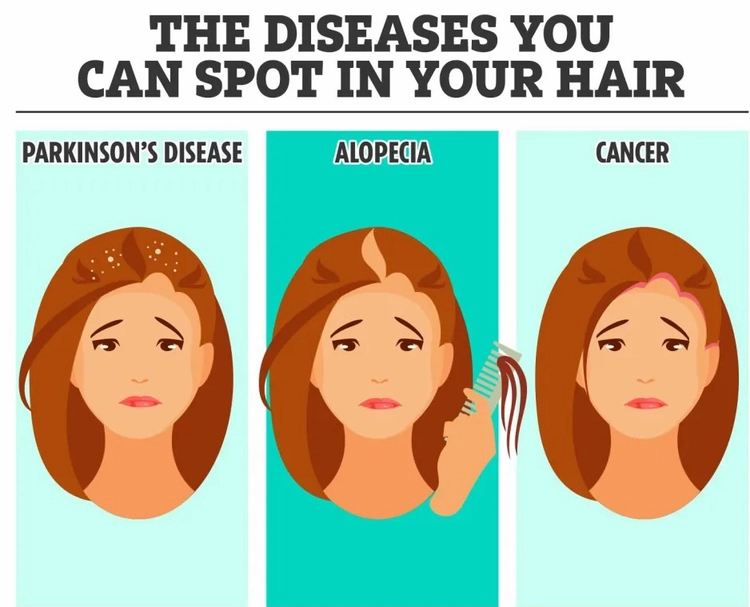
In some cases, however, changes in hair can be a sign of a serious illness, according to “The Sun”.
Parkinson’s Disease
While white dandruff is very common, yellow dandruff can be a sign of Parkinson’s disease.
Parkinson’s is a neurological disease that worsens over time.
It is usually associated with tremors, stiffness or even slow movement.
Yellow dandruff caused by seborrheic dermatitis is a condition in which areas of skin with many sweat glands, such as the scalp, become red, itchy, damaged and flaky.
According to the charity Parkinson’s UK, people with Parkinson’s disease are prone to problems with this skin condition.
Although there is no cure for Parkinson’s, there are treatments and therapies that help manage it.
Alopecia
If you notice small patches on your head, the size of a coin, where your hair has fallen out, you may be suffering from a form of alopecia areata.
This autoimmune disease can also appear in other parts of the body, including the beard, eyebrows and eyelashes.
The disease occurs when cells attack hair follicles, stopping them from producing hair.
The cause is unclear, but iron deficiency and stress may trigger the condition, although many experts disagree.
In some cases, alopecia areata can develop into alopecia totalis, in which hair falls out completely, or alopecia universalis, which affects the whole body.
Although there is no cure, several treatments are available, but none is guaranteed to work.
Cancer
Red and purple patches on the scalp or along the hairline may be a sign of a rare and deadly form of blood vessel cancer.
Angiosarcoma develops in the inner lining of blood vessels and in lymph nodes.
It can appear anywhere on the body, but usually shows up on the skin of the scalp, head or neck.
According to the Cleveland Clinic, it usually appears as a bluish-red lump or plaque on the skin of the head, face or ears.
When angiosarcoma affects organs such as the liver or heart, it can cause pain.
It most often affects older people, but can affect any age.
The cause of angiosarcoma is not known.
Treatments include surgery, radiotherapy and chemotherapy.
However, only 33% of those affected are likely to survive for five years.
Our editorial team writes and publishes its articles with the help of AI, and every article is reviewed by our editors.









