







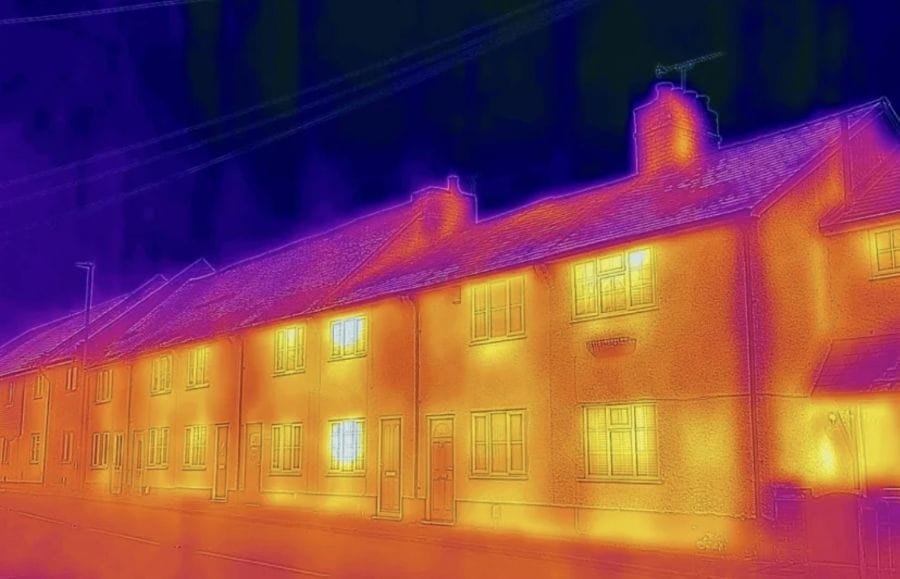
One of the lightest and most insulating materials in the world could soon become part of building and renovating homes. It is aerogel, an extremely porous material that blocks the passage of heat and could help reduce energy use for heating and cooling.
According to the scientific magazine New Scientist, innovative companies in the United Kingdom and France are preparing to produce aerogel on an industrial scale, aiming to tackle one of the biggest problems of old buildings: heat loss through walls and roofs.
The technology could be especially useful for historic homes and buildings where traditional insulation is difficult or expensive.
What is aerogel and why does it insulate so well?
Aerogel is a very light synthetic material whose structure contains an extremely large number of microscopic pores.
Wim Malfait, a researcher at the Swiss Federal Laboratories for Materials Science and Technology (EMPA), explains that aerogel is essentially a solid that contains a lot of air.
Its structure keeps air molecules confined in very small pores, slowing the transfer of heat.
This means a relatively thin layer of aerogel can provide very good thermal insulation.
The material may also have useful features, such as fire resistance and vapor permeability, depending on the product’s formulation.
Why could it be a solution for old homes?
In the United Kingdom alone, there are around eight million homes with solid masonry walls, most of them built before the 1920s.
Insulating them is often complicated.
Some buildings cannot be insulated from the outside because of restrictions that protect their historic appearance, while internal insulation can reduce living space and, if designed incorrectly, cause problems with dampness and mold.
Aerogel can be used as an ingredient in insulating plaster, allowing thinner layers to be applied to existing walls.
In this way, owners can improve insulation without major changes to the building’s structure.
British company develops insulating plaster with aerogel
The British company Thermulon has developed a new production method that, according to the company, uses cheaper materials, less energy and equipment better suited to industrial manufacturing.
It is working with British manufacturer Best of Lime to create a lime plaster that contains aerogel.
The plaster is designed especially for insulating old and historic buildings.
Sam Cryer of Thermulon says insulation through plaster could be the first product the company brings to market.
According to plans reported by New Scientist, the company aims to begin commercial production in Northern Ireland during 2027, with an initial capacity of around 100 tons of aerogel per year.
France is also developing a coating that keeps roofs cooler
Meanwhile, the French company Keey Aerogel is taking a different approach.
It is developing aerogel using silica waste from the construction industry and solvents that are continuously recycled during production.
According to founder Francisco Ruiz, the company’s process has a carbon footprint about three times smaller than traditional aerogel production methods.
The company is working on materials for insulating external walls, filling the spaces between walls, and a special coating for roofs.
The roof coating is designed to reflect sunlight and prevent heat from entering during the summer months.
Keey Aerogel secured 18 million euros in investment in 2025, including support from the French government.
Its first factory, near the city of Mulhouse in eastern France, is planned to begin production in 2027, with a capacity of 1,000 to 2,000 tons per year.
Could heating and electricity bills come down?
Better insulation of buildings can reduce heat loss during winter and heat gain during summer.
As a result, homes may need less energy for heating and cooling.
This is especially important in Europe, where many old buildings have low energy efficiency.
However, actual savings will depend on the quality of existing insulation, the climate, the heating system and the installation method.
Aerogel does not automatically make a building net-zero for emissions, but it could be one of the technologies that help reach that goal.
Price remains the main obstacle
Despite its advantages, aerogel remains more expensive than traditional insulation materials.
Its production has historically required complex processes and large amounts of energy, which has limited its use mainly to industry, aviation and space technology.
The new methods aim to reduce this cost.
However, researcher Wim Malfait warns that companies will need to convince consumers that the long-term benefits justify the initial price.
For some buildings where traditional insulation is difficult, aerogel could be one of the most suitable solutions.
If industrial production develops according to plans, aerogel could open a new chapter in the energy renovation of homes, combining advanced insulation with smaller interventions in building structures.
Originally published in Albanian on Reporteri.net. We use AI to help translate and publish our articles, and every article is reviewed by our editors.








