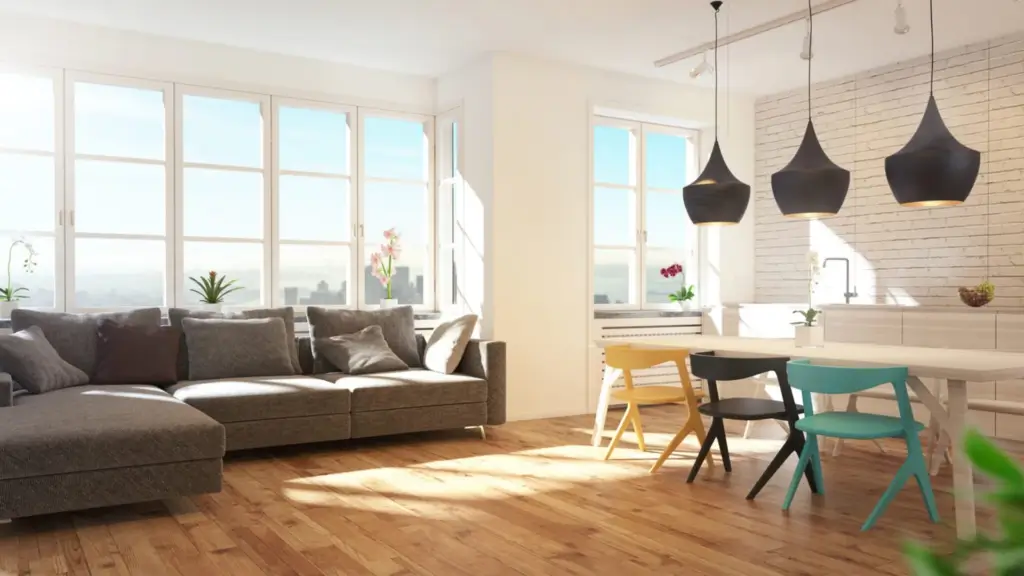
Living in a small home doesn’t mean giving up on furniture or decor. With a few smart choices, a space can look much larger and airier.
Furniture with the right proportions, fewer decorative plants and built-in cabinets are just some of the solutions that can help. Milan-based interior designer Angela Archinà, creator of the “Scandi Jungle Gold” style, explains which elements are best avoided.
1. The oversized sofa
In a small room, a very deep sofa, one with large armrests or one placed where it blocks passage can overwhelm the space.
Comfort does not necessarily depend on the number of seats, but on the right balance between filled and empty space.
2. The large coffee table in the center
A large, dark table with a heavy base can take up the central space of the room and make movement more difficult.
Instead, lighter designs are recommended: transparent ones, movable ones, or ones with thin legs and glass tops.
3. Too many small pieces of furniture
Dressers, shelves, small pieces of furniture, shoe racks or decorative trolleys may seem harmless on their own, but when they are gathered in one space, they create visual clutter.
A better solution may be a single storage system that covers one wall and organizes everything more neatly.
4. Decorations with no function
An unused chair, an extra lamp, a pouf, small side tables or magazine racks that are there only for decoration eat up space without serving any real function.
The rule is simple: if an object serves no purpose, it may be time to remove it.
5. Poorly chosen rugs, curtains, plants and paintings
Decorative elements can also make a room look smaller if they do not respect its proportions.
A rug that is too small visually splits the room into pieces. Curtains hung directly above windows or ending halfway down the wall can make the ceiling look lower. For this reason, it is better to mount them close to the ceiling and let them fall to the floor.
Plants should also be used in moderation. Instead of many small pots scattered everywhere, you can choose one or two larger plants placed in strategic positions.
The same goes for paintings: many small pictures across the walls can fragment the space. A larger artwork or a well-thought-out arrangement can create a focal point and give the room character.
What about wardrobes and bookcases?
In a small home, storage space is essential, but it needs to be organized smartly. A built-in wardrobe that reaches the ceiling and matches the color of the walls usually works better than several low, separate pieces of furniture.
Spaces that are usually left unused can also be turned into storage: alcoves, the space under the stairs, wide hallways, the area above doors, and the zones around columns and corners.
Bookcases can also be a good solution, as long as they are not filled to the top. Combining open spaces with closed ones helps the furniture look lighter.
Overall, a few carefully chosen pieces of furniture work better than many small ones. Too many elements create visual breaks and make the space look cluttered. One main piece of furniture in the right proportions, paired with lighter elements, can make the space look larger and more harmonious.
Originally published in Albanian on Reporteri.net. We use AI to help translate and publish our articles, and every article is reviewed by our editors.