







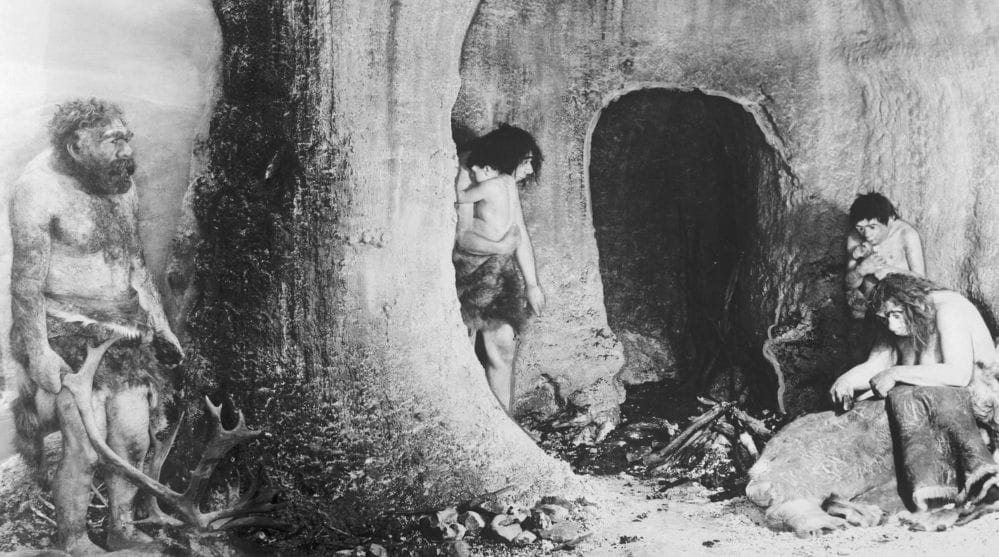
Clothing is one of the most important inventions in human history. It allowed our ancestors to survive extreme temperatures, spread across different continents and, later, develop new forms of social organization. But when did people first start wearing clothes? Scientists still do not have a definitive answer, although they have uncovered some surprising traces.
In an article published in the American magazine The Atlantic, science journalist Sarah Zhang reviews archaeological and genetic studies that seek to determine the origins of human clothing.
According to researchers, clothing was not initially a matter of fashion or decoration. It was a technology that allowed humans to survive in environments where their bodies could not withstand the cold.
Archaeologist Ian Gilligan describes clothing as a form of thermal protection that people could carry with them.
Without this invention, our ancestors would hardly have been able to live in Siberia during the coldest periods of the Ice Age, or to cross into America through the Bering region some 20,000 years ago.
Why haven’t very ancient clothing remains been found?
One of the main problems for archaeologists is that the materials used for early clothing decompose over time.
Animal hides, plant fibers and other organic materials do not preserve easily for tens of thousands of years.
According to The Atlantic, no preserved garment older than 5,000 years has been found.
However, this does not mean people began wearing clothes only then.
To trace the origins of clothing, scientists have used indirect methods, including analysis of parasites, stone tools and animal remains.
Body lice reveal a 170,000-year-old secret
One of the most interesting pieces of evidence comes from the study of lice.
Head lice live mainly in human hair, while body lice have adapted to live and reproduce in clothing.
Scientists have compared the DNA of these two populations to understand when they may have separated from each other.
A 2011 genetic study suggests that this separation occurred approximately 83,000 to 170,000 years ago.
This is an indication that modern humans may have worn clothing from that period.
However, the dating is an estimate based on genetic analysis, not direct evidence of a preserved garment.
Tools 800,000 years old suggest clothing may be even older
Other evidence suggests that the use of animal hides may have begun much earlier, even before the emergence of modern humans.
At archaeological sites in China and Spain, dating back roughly 800,000 years, stone tools have been discovered that resemble implements used to clean and process hides.
Researchers think these tools may have been used by early human species such as Homo erectus and Homo antecessor.
About 300,000 years ago, in what is today Germany, similar tools and bear bones with cut marks were also found.
These traces suggest that the skins of animals may have been removed to use the fur.
But archaeologists stress that such tools do not conclusively prove that hides were used as clothing. They may have served other functions too.
Neanderthals may also have made clothing
Neanderthals, who lived in Europe long before Homo sapiens arrived, most likely used clothing to protect themselves from cold winters.
Archaeologists have discovered smoothed fragments of deer antler that resemble modern tools for processing hide.
Experiments with similar tools have shown that they can leave microscopic marks on bone surfaces comparable to those found on Neanderthal objects.
According to archaeologist Shannon McPherron, these are important evidence of hide processing.
However, it is not possible to prove exactly what the processed materials were used for.
A modeling study suggests that Neanderthals may have needed to cover up to 80% of their bodies to cope with the cold temperatures.
Why did humans lose their body hair?
To understand the origins of clothing, scientists have also examined the evolution of the human body.
Our ancestors are thought to have lost most of their body hair during evolution in hot African environments.
This allowed them to cool down more effectively through sweating.
According to paleoanthropologist Daniel Lieberman of Harvard University, humans have about ten times more sweat glands per unit of skin area than chimpanzees.
Evaporation of sweat from the skin helps lower body temperature, making humans particularly well suited to physical activity in high temperatures.
But this advantage in hot climates became a weakness when humans began to spread into cold regions.
Without thick body hair, the body needed another way to retain heat.
Thus, clothing became an essential solution for survival.
The invention of the needle changed the way people dressed
According to Ian Gilligan, there is an important difference between simple clothing and clothing tailored to the shape of the body.
The earliest garments may have been animal hides thrown over the shoulders or wrapped around the body.
They offered protection from the cold, but were not very effective against wind.
More complex garments, such as those with sleeves and closed parts for the legs, provided better thermal insulation.
But making them required specialized tools, including eyed needles for threading fiber.
Needles like these, dating back at least 40,000 years, have been found in Russia.
Needles dating to around 30,000 years ago have also been found in China.
These discoveries show that modern humans had developed more sophisticated techniques for producing clothing.
Did clothing also influence the birth of agriculture?
One of the most interesting hypotheses presented in the article relates to the influence of clothing on the development of agriculture.
After the end of the Ice Age, around 10,000 years ago, temperatures rose and thick animal hides were no longer suitable for every season.
People began to use lighter materials made from plant fibers.
According to Gilligan, the demand for such materials may have been one of the factors that pushed human communities toward cultivating plants.
In this sense, clothing may have influenced not only how people protected themselves from the climate, but also the development of economic and agricultural activities.
However, the researcher himself acknowledges that this hypothesis remains unproven.
From survival to social identity
Over time, clothing gained a significance that went beyond protection from temperatures.
It began to serve social and cultural functions as well.
As the climate changed and production techniques advanced, people developed increasingly varied ways of dressing.
According to Gilligan, the ability to produce and use clothing is one of the traits that distinguishes humans from their closest relatives in the animal world.
Although scientists still do not know exactly when the first garment was made, the evidence suggests its history is much longer than the objects preserved in museums would suggest.
And what is seen today as an ordinary part of daily life was once an invention that helped humanity conquer new environments and survive extreme conditions.
Originally published in Albanian on Reporteri.net. We use AI to help translate and publish our articles, and every article is reviewed by our editors.








