







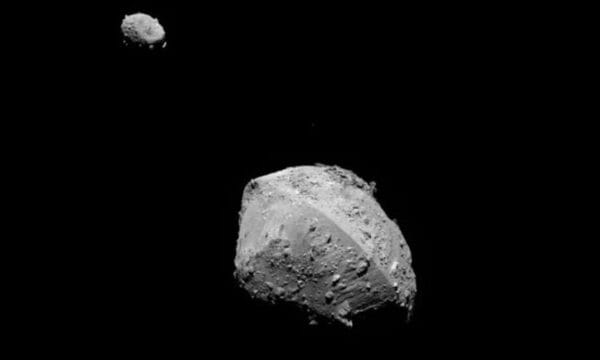
Four years after NASA’s historic mission to change the orbit of the asteroid Dimorphos, the European Space Agency (ESA) has published the first close-up images showing the effects of the deliberate impact.
The photographs, obtained by ESA’s Hera mission, reveal a giant crater on the surface of Dimorphos, roughly the size of a soccer field. The asteroid is just 151 meters in diameter and orbits the larger asteroid Didymos.
The images show the changes caused by NASA’s DART mission, which in 2022 deliberately crashed into Dimorphos to test whether a controlled impact could alter the path of an asteroid that could pose a threat to Earth.
Hundreds of rocks move near the asteroid
One of the discoveries that has surprised ESA scientists is the presence of hundreds of rocks moving near Dimorphos. They are located at small distances from the asteroid but do not fall back onto its surface, since the gravity of this celestial body is too weak to pull them back.
After the 2022 impact, scientists found that the DART mission had succeeded in changing Dimorphos’s orbit around Didymos. The new data show that the asteroid is still affected by the collision and that its motion remains irregular.
Hera mission to study the asteroid more closely
The next phase of the Hera mission plans to deploy two small satellites, which will get even closer to Dimorphos to study its surface and characteristics. According to the published data, the Hera spacecraft is currently about 30 kilometers from the asteroid.
One of the main questions scientists hope to answer is why Dimorphos was not completely destroyed by the impact of the DART spacecraft.
The 2022 experiment was an important step in developing technologies to protect Earth from asteroids. The idea is that if a celestial body poses a threat to our planet, a controlled impact could change its orbit and move it off its collision course.
ESA and the Japanese Space Agency have long been studying such methods, with the aim of preventing a possible catastrophe caused by an asteroid.
Scientists stress that this is a natural hazard that should not be underestimated, while expressing satisfaction that the importance of planetary defense is increasingly understood by the public and policymakers as well.
Another important mission in this area is Ramses, which is scheduled to meet the asteroid Apophis in 2029, during its close approach to Earth.
Originally published in Albanian on Reporteri.net. We use AI to help translate and publish our articles, and every article is reviewed by our editors.








