







A new technology developed by researchers at the Swiss Federal Institute of Technology in Zurich (ETH Zurich) could change the way people communicate with artificial intelligence.
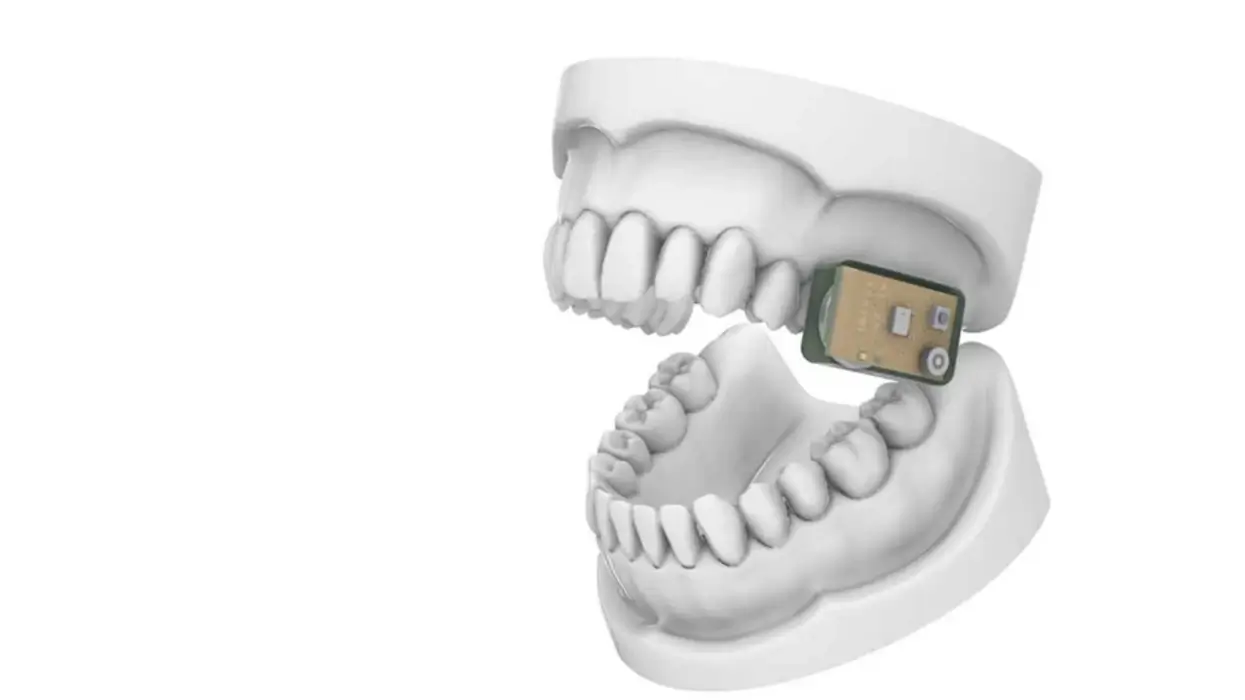
The device is a small sensor called “InvisiSpeech” that is placed next to a back tooth and allows users to send commands without speaking any words or moving their lips.
The device works by recording the very small vibrations created in the mouth when the user forms words with their tongue, but without pronouncing them aloud.
The data is then transmitted to a smartphone, where an artificial intelligence model interprets the words and converts them into commands.
The sensor was developed by researchers at the Sensing, Interaction & Perception Lab (SIPLAB), under the direction of computer science professor Christian Holz at ETH Zurich.
The device is fitted as a small holder between the back tooth and the cheek, remaining invisible from the outside.
It contains the sensor, a battery and the electronics for wireless data transmission.
In initial tests involving 15 people, the system correctly identified about 90% of 50 predefined commands in English.
According to the researchers, the device performed well even in noisy environments, and each user needed only a short calibration.
The technology has been tested for several functions, including turning devices on and off with silent commands, retrieving information during a meeting, and translating content into foreign languages through AI-powered smart glasses.
One of the main goals of the researchers is to enable natural conversations with artificial intelligence, similar to voice communication with virtual assistants.
Users will be able to form their questions without speaking, while the answers will be heard through headphones.
This could be especially useful on public transport, in offices, or in other settings where people want to communicate with AI without drawing the attention of others.
The researchers stress that the device requires no implant or surgical procedure and can be easily put in and taken out.
Unlike interfaces that connect the brain to a computer, “InvisiSpeech” does not measure brain signals, only the vibrations produced in the mouth while forming words.
However, the technology is not yet fully ready for everyday use. The main challenges remain recognizing longer and more complex sentences, as well as reliable operation while walking or during rapid movements.
Besides ETH Zurich, researchers from Aarhus University in Denmark and Penn State University in the United States also contributed to the technology.
The development of “InvisiSpeech” marks a new step in the interaction between people and artificial intelligence, opening the way to more discreet communication without sound, and without bystanders needing to realize that the user is communicating with an AI system.
Originally published in Albanian on Reporteri.net. Translated from Albanian with the help of AI.








