







A simple photo of a person’s face may contain important data about their health and longevity. A new study suggests that artificial intelligence can use this data to estimate biological age and predict the risk of death among cancer patients.
Researchers from Mass General Brigham, in Boston, United States, have developed artificial intelligence (AI) models that analyze a single facial photo to assess the overall health and survival chances of cancer patients.
The study, published in the scientific journal The Lancet Digital Health, suggests that facial analysis could serve in the future as an additional tool for doctors when assessing patients’ condition and considering treatment options.
How does artificial intelligence work?
The AI models were trained on more than 40 million photos of faces of people of different ages and backgrounds.
The researchers developed two specialized models. The first, FAHR-FaceAge, estimates a person’s biological age based on facial features. The second, FAHR-FaceSurvival, predicts the risk of death in cancer patients by combining facial analysis with other clinical information.
Unlike chronological age, which reflects the number of years lived, biological age reflects the rate at which the body is aging. However, the AI’s estimate in this study is based on appearance and does not directly measure the biological processes of aging.
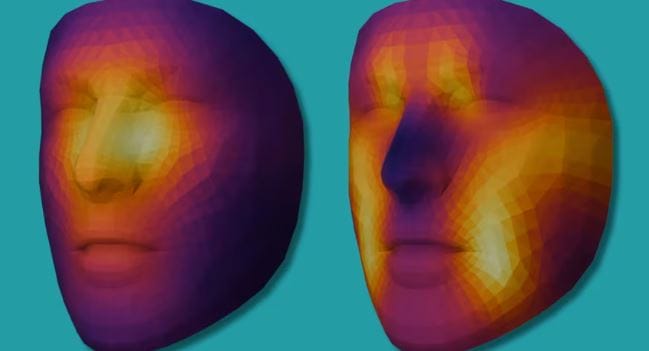
According to the researchers, the model that estimates biological age analyzes areas such as the temples, forehead, the area above the eyes, and the lines running from the nose toward the corners of the mouth.
The model that predicts the risk of death focuses on other areas, including the bridge of the nose and the area under the eyes.
The study’s author, Dr. Raymond Mak, a radiation oncologist at the Mass General Brigham Cancer Institute, said he was surprised by the possibility of identifying signs linked to the risk of death from a facial photo alone.
He also pointed to similarities between the areas analyzed by the algorithms and the descriptions of the ancient physician Hippocrates, who around 400 BC mentioned features such as a sharp nose, sunken eyes and fallen temples as signs that could accompany serious health conditions.
However, the algorithms were not trained on the writings of Hippocrates, but only on photos of faces and data on people’s age or mortality.
What did the results show?
In evaluating the FAHR-FaceSurvival model, the researchers analyzed the outcomes of cancer patients according to the predicted risk levels.
52.5% of the 122 patients the model placed in the highest-risk group died within 90 days of the assessment.
In the lowest-risk group, which included 975 patients, about 2% died within 90 days.
The biological age assessment also produced distinct results. Of the 1,060 patients whose biological age was estimated to be more than 20 years above their chronological age, 21% died within 90 days.
By contrast, among the 4,195 patients whose biological age was estimated to be at least 10 years lower than their chronological age, about 6% died within the same period.
The researchers also reported that cosmetic changes to the face, such as surgical procedures, Botox injections or the use of makeup, did not affect the models’ performance.
Could this technology be used in hospitals?
The authors stress that the AI models are not intended to replace doctors or existing clinical assessments. The idea is that they serve as supplementary tools to help identify patients who may need further testing or closer evaluation.
According to Dr. Mak, early identification of signs linked to accelerated aging or a higher mortality risk could help determine which patients need additional investigation.
However, experts warn that the results must be interpreted with caution.
Dr. Wilbur Lam, a professor of pediatrics and biomedical engineering at Emory University, described the study as interesting, but stressed that its real value in clinical practice must be proven through further studies.
Meanwhile, Miroslaw Bober, a professor of video processing and machine intelligence at the University of Surrey, pointed out that a statistical link between facial appearance and survival does not necessarily mean the algorithm explains the causes of this risk.
According to him, it remains to be established whether AI predictions provide additional information of clinical value beyond doctors’ assessment of a patient’s overall condition.
In addition, the technology must be tested in different hospitals and on different groups of patients, to determine whether the results are reliable regardless of age, skin color and facial features.
Originally published in Albanian on Reporteri.net. Translated from Albanian with the help of AI.








