







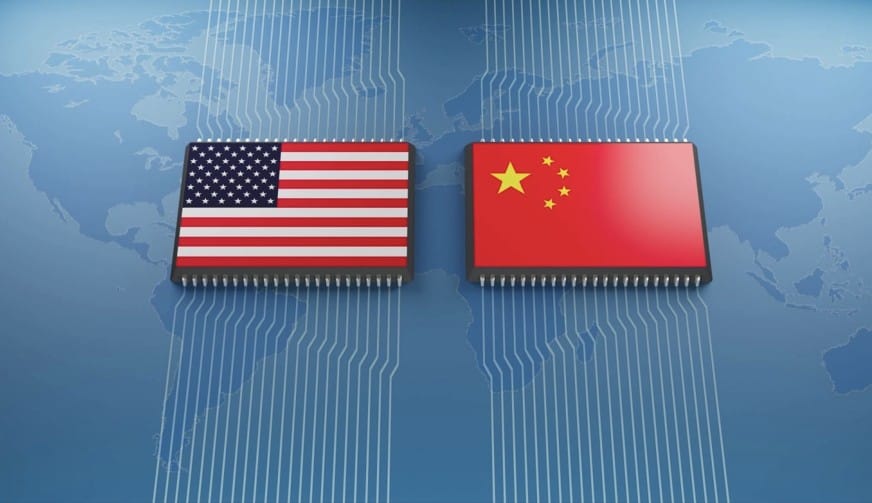
The United States continues to lead the global race to develop artificial intelligence, but its edge over China is much smaller than it may seem. According to a well-known American expert, Chinese companies are only six to nine months behind their American rivals in developing the most powerful AI models.
Matt Sheehan, senior fellow at the Carnegie Endowment for International Peace and co-director of its initiative on AI in China, has said in an interview with Foreign Policy that the technology race between the two superpowers is far more complex than a contest to build the smartest model.
According to him, while American companies such as OpenAI, Anthropic and Google DeepMind aim to develop artificial general intelligence and, potentially, superintelligence, China is placing particular emphasis on using AI in the economy, industry and scientific research.
China could catch up with American models within a few months
Sheehan explains that the US retains a clear lead in what experts call the most advanced AI capabilities, or frontier capabilities.
This refers to the most powerful models, capable of carrying out increasingly complex tasks in programming, mathematics, scientific research and reasoning.
However, according to his assessment, this lead is not large.
If an American company releases a new model with advanced capabilities today, Chinese companies could reach a similar level within six to nine months.
This is not an exact measurement of the technological gap, but an approximate assessment by experts.
Sheehan stresses that there are still open questions about how China is narrowing this gap, including the role of domestic research and the use of technologies developed in the US.
Americans aim for superintelligence, China for AI use in the economy
One of the most important differences between the two countries concerns how they define success.
Leading American companies are investing heavily in developing artificial general intelligence, known as AGI.
This would be a technology capable of performing a very wide range of intellectual tasks at a level comparable to humans.
The even more ambitious goal is artificial superintelligence, or ASI, a hypothetical system that would surpass human abilities in almost every cognitive field.
A particularly important milestone in this process would be the ability of AI to help develop increasingly powerful versions of itself.
This mechanism, known as recursive self-improvement, could significantly speed up technological development.
Meanwhile, China’s approach gives great weight to spreading AI across different economic sectors.
This includes using the technology in manufacturing, automation, healthcare, scientific research and services.
The difference is essential: one country may create the most powerful AI model, but another may gain more economically by using the technology on a large scale.
Why is the US wary of regulating artificial intelligence?
The race with China has become one of Washington’s main arguments against imposing strict limits on AI development.
The American administration and industry leaders argue that overly restrictive rules could slow innovation and give Beijing the opportunity to narrow the gap even further.
But Sheehan notes an interesting contradiction.
China has put in place considerable rules for developing and using AI, including requirements for content control and system oversight.
Yet Chinese companies continue to close in on their American rivals.
This raises the question of whether regulation necessarily hinders progress, as some American companies and policymakers argue.
On the other hand, China’s regulatory system also includes strong state control over information, raising particular concerns about censorship and freedom of expression.
Who is really winning the race?
According to Sheehan, the answer depends on how success is measured.
In developing the most advanced models, the US continues to hold an advantage.
But when it comes to spreading AI through the economy and its impact on productivity, there is still not enough data to determine which country is benefiting more.
In the US, large investments in data centers and computing power are affecting economic activity.
However, this does not automatically mean that AI is already producing sustained productivity growth across the whole economy.
Even in China, the economic benefits of widespread AI use remain difficult to measure.
For this reason, the race cannot be judged solely by the power of new models.
Ultimately, the decisive factor may not be just who creates the most powerful artificial intelligence, but who manages to turn it into economic, scientific and strategic advantage.
/Reporteri.net/
Originally published in Albanian on Reporteri.net. We use AI to help translate and publish our articles, and every article is reviewed by our editors.








