







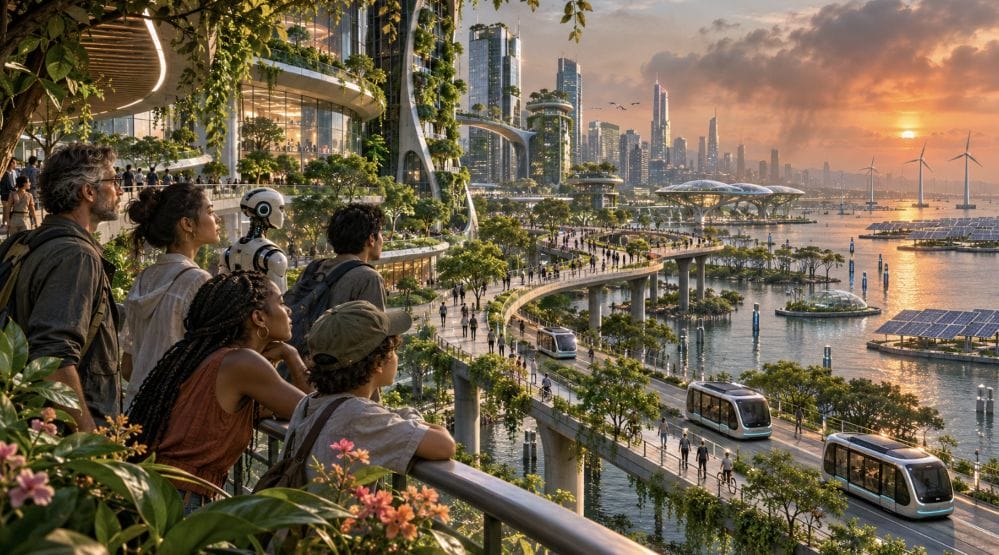
How will people live 70 years from now? Will artificial intelligence be part of every aspect of life, will the world population keep growing, and how will climate change affect the future of humanity?
These are some of the questions the science magazine New Scientist has explored to mark its 70th anniversary, through a project that tries to imagine the world in 2096 by combining scientific knowledge with imagination.
Author Jacob Aron explained that, to build this scenario, he relied on scientific studies, demographic forecasts and conversations with dozens of experts from different fields.
However, he stresses that the project does not aim to present a certain prediction of the future, but a possible scenario based partly on today’s developments and knowledge.
The world may face a population decline
One of the most interesting developments Aron identified during his research concerns demographics.
For most of modern history, the world population has been growing. However, demographic projections suggest this trend could change in the coming decades.
In the scenario presented by New Scientist, the end of the 21st century could be a period when humanity faces a global population decline.
This would represent a significant demographic shift, with possible consequences for the economy, the labor market and the organization of societies.
The author explains that demographic forecasts are among the elements that can be studied with a relatively high degree of reliability, since they are based on current birth trends and population structure.
Climate change will shape the world of 2096
Another central element of the project is climate change.
According to Aron, science has developed models that make it possible to calculate possible changes in the climate up to the end of the century.
However, the final outcome will depend on the decisions humanity makes in the coming decades.
In this regard, the author stresses that scientific models can show different scenarios, but cannot predict with certainty the political and economic decisions that will determine the level of emissions and global warming.
For this reason, imagining the world of 2096 requires combining scientific knowledge with assumptions about how human societies will act.
Artificial intelligence, the hardest challenge to predict
The author admits that artificial intelligence was the most difficult part of the project.
According to him, the rapid development of this technology makes it extremely difficult to predict its impact even a few years ahead, let alone for seven decades.
Aron explains that his views on artificial intelligence have changed since the launch of ChatGPT in 2022.
He notes that scenarios for the future of artificial intelligence range from the possibility of a world of economic abundance to existential risks for humanity.
For his project, the author chose a more moderate scenario.
He imagined a financial crisis caused by artificial intelligence, which would push societies to impose restrictions on the use of the technology.
However, Aron openly acknowledges that this crisis is a fictional element of the narrative and that he does not know whether such an event is likely to happen.
Could animals and artificial intelligence gain rights similar to those of humans?
One of the project’s most unusual ideas concerns expanding the legal concept of personhood.
Aron examined the possibility that in the future, legal subject status would not be limited to people.
Taking into account changing attitudes toward animals and the development of artificial intelligence, he imagined an international agreement recognizing the legal status of non-human beings.
In his narrative, this imagined agreement shapes how society is organized and the relationships between people and other beings.
However, this is the author’s hypothesis about the future, not a development that has been predicted or confirmed scientifically.
Scientists are not studying enough the combined impact of technologies
While preparing the project, Aron spoke with dozens of experts to understand how different scientific fields might develop.
One of the conclusions that surprised him was the lack of studies that analyze in an integrated way how various developments affect one another.
For example, research on the future of public health has only recently begun to take more into account how climate change may affect the spread of diseases.
Likewise, according to him, many experts have not examined in depth the impact that artificial intelligence may have on their disciplines.
This makes it even harder to build a reliable picture of the world 70 years from now.
Can science predict the world 70 years from now?
Aron stresses that imagining the year 2096 is an exercise that requires both scientific knowledge and imagination.
According to him, some developments, such as climate change and demographic trends, can be analyzed through models and existing data.
But other developments, especially those related to artificial intelligence, politics and social transformations, remain far more uncertain.
The author notes that 70 years from now he himself would be 110 years old, and that most of the experts he interviewed will probably no longer be alive to see whether their scenarios came true.
It is precisely this time gap, he says, that makes the year 2096 especially interesting for thinking about the future.
The author concludes that science can help us understand the direction of some changes, but cannot tell us with certainty what the world will look like in seven decades.
/Reporteri.net
Originally published in Albanian on Reporteri.net. Translated from Albanian with the help of AI.








