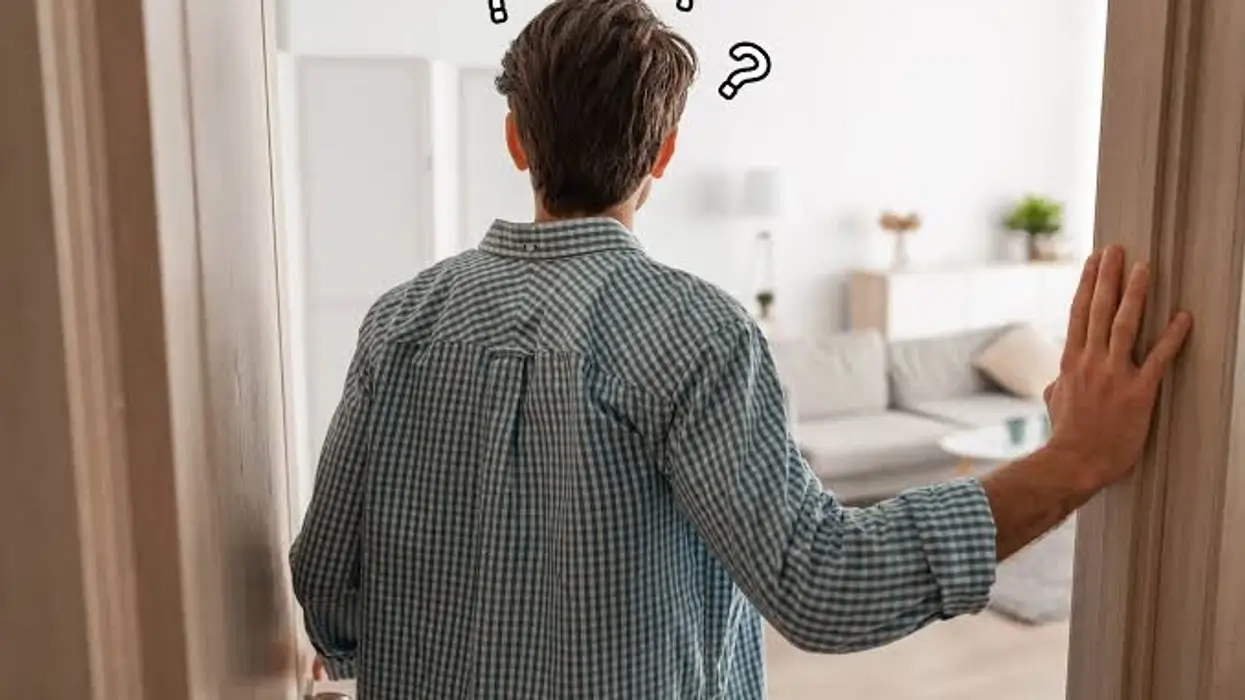
A common experience many people have may be linked to how the brain processes information, changes in the environment and attention. Scientific studies have examined this phenomenon, but they show that it does not always happen for the same reason.
Have you ever stood up from the sofa, walked into the kitchen or another room and, as soon as you arrived, completely forgotten what you were looking for? You may stand there for a few seconds trying to recall your purpose, until sometimes it comes back to you once you return to the place where you were before.
This everyday situation has drawn the attention of psychology and memory researchers. In the scientific literature it is known as the “doorway effect” (doorway effect), or the location-updating effect.
What happens in the brain when we move from one room to another?
One proposed explanation is that the brain organizes our experience into events and distinct situations. When we change environments, it may update its mental representation of the situation, making information linked to the previous moment less accessible.
For example, you may be thinking of getting a glass of water, but on the way to the kitchen your attention shifts to something else. When you enter the kitchen, the original goal may not come to mind right away.
However, this does not mean the brain erases the memory. In many cases, it is a temporary difficulty in recalling information, not necessarily its loss.
What have scientific studies found?
A study published in 2006 by psychologists Gabriel Radvansky and David Copeland, in the journal Memory & Cognition, examined how a change of environment affects memory for objects. The researchers found that information about some objects became less accessible after participants moved into another space.
Scientific study
In 2011, Radvansky, Sabine Krawietz and Andrea Tamplin investigated this phenomenon further, using both virtual environments and a physical setting. The results showed that the location-change effect could appear in both conditions. The 2011 study
But later research has shown that the phenomenon is not as simple as it may seem.
A study published in 2021 in the journal BMC Psychology tested the effect through four experiments, including virtual reality and movement in real environments. The researchers did not find a consistent doorway effect on forgetting across all experiments. However, when participants had a greater load on their working memory, some difficulties were observed in distinguishing accurate information from inaccurate information.
This shows that moving from one room to another does not automatically make us forget, and that other factors, including mental load and attention, may matter. The 2021 study
Is it the door or distraction?
Scientists do not consider the door to be a single, proven cause of forgetting. One possible explanation is that a change of environment acts as a boundary between two mental situations, affecting how we recall what we were doing before.
Distraction can also play a role. If we are thinking about several things at once, the goal we had in mind may temporarily slip out of focus.
So when we walk into a room and forget the reason we went there, we should not immediately conclude that we have a memory problem. This is a phenomenon that has been studied in cognitive psychology, but its full explanation remains open for further research.
How can we avoid this everyday forgetfulness?
Although we cannot always control how memory works, some practical habits may help:
Focus on the goal: Before you leave, briefly repeat to yourself what you want to do.
Avoid distractions: If possible, try not to move straight to another thought on the way.
Use notes: For important tasks, a note on your phone or on paper can help you avoid relying on memory alone.
Return to the starting context: If you forget what you were looking for, sometimes returning to the place where you were and the action you were doing can help you reconstruct the goal.
When should we pay more attention to forgetfulness?
Occasionally forgetting a minor goal is different from frequent memory problems that interfere with everyday life. If forgetfulness becomes persistent, worsens or is accompanied by difficulty carrying out routine tasks, it is reasonable to seek medical advice.
According to the American Psychological Association (APA), memory problems that interfere with daily functioning deserve professional evaluation.
Originally published in Albanian on Reporteri.net. We use AI to help translate and publish our articles, and every article is reviewed by our editors.