




The entertainment industry is one of the most dynamic sectors in modern economic history. From the birth of cinema to the rise of streaming platforms and digital gaming, each decade has brought innovations that fundamentally reshaped how people spend their leisure time. Tracing these milestones not only reveals technological progress — it tells the story of how human beings have sought connection, escapism, and stimulation across generations.
The Birth of Mass Entertainment (1890s–1930s)
The late 19th century marked the beginning of entertainment as an industry rather than a purely communal or aristocratic privilege. Thomas Edison’s kinetoscope (1891) and the Lumière brothers’ first public film screenings (1895) introduced moving pictures to mass audiences. Within two decades, Hollywood had emerged as a global production hub.
Radio followed, transforming the living room into an entertainment space. By the 1930s, millions of families across Europe and North America gathered around the receiver each evening — a behavioural shift that advertisers were quick to exploit. The concept of a “broadcast audience” was born, and with it the commercial entertainment model that still underpins the industry today.
Television and the Post-War Boom (1940s–1970s)
Television’s rapid adoption after World War II was arguably the single most disruptive event in 20th-century entertainment. By 1960, over 90% of American households owned a TV set. Cultural events — moon landings, sporting championships, political debates — became shared experiences on an unprecedented scale.
This era also saw the professionalisation of sports entertainment. The formation of major leagues and the live broadcasting of football, boxing, and athletics turned athletes into global celebrities and stadiums into cathedrals of popular culture. Sponsorship and media rights became billion-dollar industries in their own right.
The Digital Revolution and Online Entertainment (1990s–2000s)
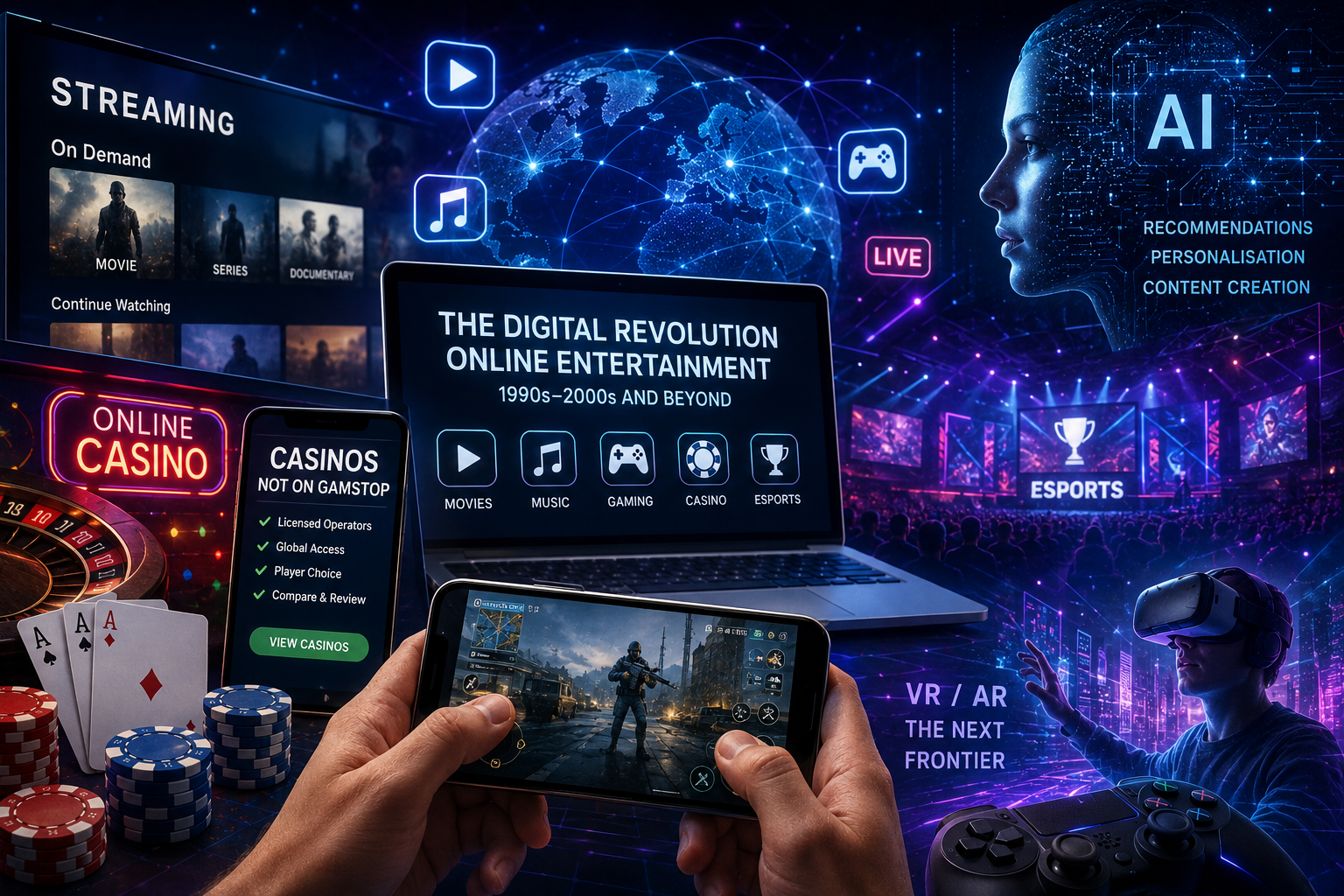
The internet changed everything — and the entertainment sector was among the first to feel the full force of that disruption. Music, film, gaming, and gambling all migrated online within a remarkably short timeframe.
Online gaming and digital casinos represent one of the most striking examples of this migration. The first licensed online casinos appeared in 1994 following the passage of the Free Trade and Processing Act in Antigua and Barbuda. What followed was explosive global growth. Today, platforms catering to international audiences offer hundreds of games accessible from any device. For players seeking broader access, dedicated comparison portals covering casinos not on GamStop have become an established part of the digital gambling landscape, offering structured overviews of operators licensed outside the UK’s self-exclusion scheme. The existence of such platforms reflects how deeply fragmented and consumer-driven the digital entertainment market has become, with regulation, accessibility, and user choice now at the centre of industry debate.
Streaming and the On-Demand Economy (2010s)
Netflix launched its streaming service in 2007, but it was the 2010s that cemented on-demand content as the dominant paradigm. By 2023, global streaming revenues exceeded $100 billion annually. Traditional broadcasters scrambled to adapt, launching their own platforms in a wave of consolidation that continues today.
Gaming underwent a parallel transformation. The rise of mobile gaming democratised access — by 2020, over 2.5 billion people played games on smartphones. Esports emerged as a legitimate spectator discipline, with tournament prize pools rivalling those of traditional sports. Platforms like Twitch and YouTube Gaming created an entirely new entertainment category: watching other people play.
Artificial Intelligence and the Next Frontier
The most recent milestone — still unfolding — is the integration of artificial intelligence into content creation, personalisation, and interactive entertainment. AI-driven recommendation engines already determine what billions of people watch, listen to, and play each day. Generative AI is beginning to produce music, screenplays, and game assets, raising profound questions about authorship, creative labour, and intellectual property.
Virtual and augmented reality, long promised and often delayed, are gradually finding their footing in gaming and live events. The metaverse concept — persistent, immersive digital environments — remains speculative at scale, but the infrastructure being built in its pursuit will likely shape entertainment for decades to come.
Conclusion
From Edison’s flickering kinetoscope to AI-generated content, the entertainment industry’s milestones share a common thread: each breakthrough expanded access, reduced barriers, and invited more people into the audience. The commercial and cultural consequences have been immense. Understanding this trajectory is essential not only for industry professionals, but for anyone seeking to make sense of how modern societies consume stories, games, sport, and spectacle.